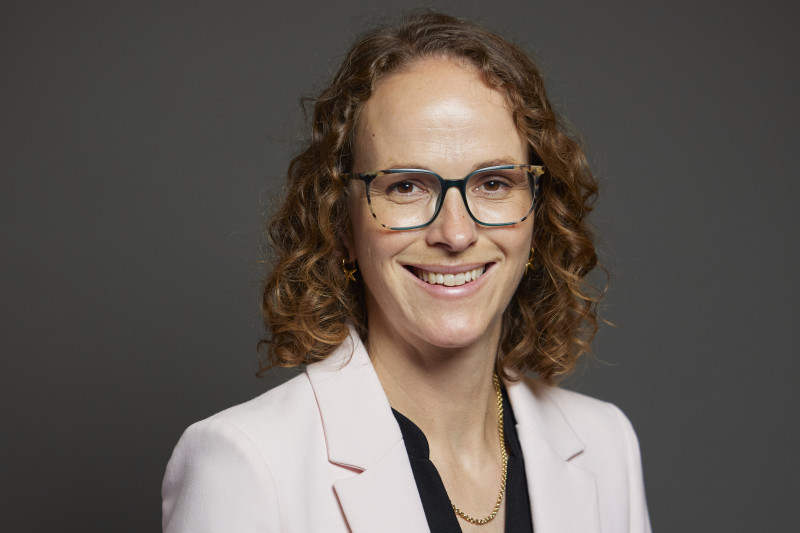
Alison Bennett became MP for Mid Sussex in July 2024, according to UK Parliament's official record, nearly a decade after joining the Liberal Democrats back in 2015, as she recounts on her constituency party's website. Now, as the party’s spokesperson for care and carers, she is trying to keep attention on a group she says is routinely overlooked, even though the country depends on them.
Bennett does not describe herself as a carer but talks about how her career break to raise children left her with a strong sense that people who spend much of their time looking after others, both unpaid carers and those working in social care, are undervalued. “It’s really valuable work,” she says. “It’s not low skilled, it’s really high skilled.”
Why is respite care in crisis?
That belief sits behind Bennett’s push for a right to respite care, through her Respite and Support Bill. The proposed legislation grew out of repeated conversations with family carers who, she says, are being pushed to breaking point. As she puts it, the aim is to make sure “family carers who are giving everything to look after their loved ones don’t burn out”.
She describes a pattern where carers keep going without support until their own health collapses. “They burn out, they end up becoming sick and not able to carry on looking after their loved ones,” she says. When that happens, pressure does not disappear, it simply shifts elsewhere.
Respite provision, she argues, has been eroded. “Across the country we can see various respite provisions being cut and being closed,” she says, leaving “a postcode lottery about whether respite care is available to you”. At the same time, carers are more likely to face financial hardship. “Family carers are much more likely to be living in poverty,” she says.
The bill is not designed to impose a fixed national entitlement as Bennett is clear that caring situations vary too much for that. “The amount of provision that anybody needs will vary according to that individual,” she says. Instead, the principle is access. “What the bill does is guarantee the right to access that respite care.”
Funding, she argues, should be viewed through the lens of prevention. “Ultimately by having access to respite care and keeping family carers able to carry on caring, what you end up with is a saving to the state overall,” she says. The alternative is greater demand on hospitals and residential care.
Why are hospital beds full of patients who could go home?
A recent intervention at Prime Minister’s Questions was shaped by a visit to University Hospitals Sussex, asking staff what they would raise with the Prime Minister. “Not just in the winter, year-round, University Hospitals Sussex have about 350 people who are medically ready for discharge but can’t get home or into a care home because there is no social care package available for them,” she says.
Staff told her it was “roughly the same number of beds” as the Princess Royal Hospital in her constituency. “That visualisation of a whole hospital of people in Sussex ready to go home but not able to, was really powerful,” she says.
Bennett is not just concerned over the cost of such delays, but also the harm to patients and staff. “The longer you are in hospital, the more likely you are to develop bedsores ... [and] at this time of year in particular, to pick up a hospital bug or norovirus,” she says. Patients are “more likely to have a fall” and to be “deconditioning”, because their “muscles are wasting”.
Between the health service and the social care sector, there need to be shared incentives
She links that to pressure elsewhere in the hospital, describing “corridor care” as a wider problem. It increases the risk that “patient harms are more likely to happen”, and that vulnerable patients are missed, especially “people who aren’t so able to advocate for themselves if they’re old or have got dementia”.
For Bennett, the repeated failure to tackle delayed discharge is partly about incentives that do not match up across the system. “Between the health service and the social care sector, there need to be shared incentives,” she says. Local government, she argues, is treated as “the Cinderella service”, lacking the visibility of hospitals and ambulances. “Social care happens behind closed doors,” she says, and “because it’s not visual for too long, it’s been easier to ignore.”
Meanwhile, she argues, ministers talk about investment in the NHS without addressing demand. “They’re not fixing the underlying causes of why there’s so much demand,” she says, pointing to an ageing population. She describes the impact as systemic. “If you don’t get the care right in the social care sector up front, you have more presentations at hospital,” she says. And if there are no packages to discharge patients, “you end up with a whole system that just isn’t working”.
Why does carer’s allowance need reform?
Bennett welcomes some recent changes to Carer’s Allowance but says the design still drives problems, including overpayments. The issue is the cliff edge. “As soon as you earn a penny more than the earnings limit, you lose all of the benefit instantly,” she says. Her party wants “a taper”, so “as your earnings increase, the amount you’re receiving, carer’s allowance goes down”.
More broadly, she argues the benefit, originally formulated in the 1970s, is outdated. “Here we are in 2025. It’s not a benefit that is designed to meet what current caring needs look like.”
On the paid workforce, Bennett argues that social care needs status and progression. The Liberal Democrats backed “a higher minimum wage for social care workers” and a “Royal College of Social Care Workers”. She supports a register too, calling it “one step towards recognising the professionalism that they already have”.
She acknowledges provider concerns about cost, but argues low pay is self-defeating. “It’s a false economy to pay people peanuts,” she says. “When you don’t pay people enough, they don’t stay in the sector.”
It’s a false economy to pay people peanuts
Why is the Casey Commission taking so long?
Bennett supports cross-party talks, but is blunt about the government’s timetable for the Casey Commission. “My big frustration” is delay. She says the Prime Minister could have started the work in July 2024, shortly after Labour’s election victory, but it did not begin until January 2025. Now, “we are staring down the gun barrel of the next general election,” she says, and she fears a report without consensus will lead to “another review” while pressures worsen.
Her principle is pragmatic. “I’m very keen that the pursuit of the perfect doesn’t get in the way of the good,” she says, arguing that urgent agreement matters more than point-scoring. In the end, she returns to the same thought: carers are not a niche interest. “I think that it’s all of us,” she says. “We never know what’s around the corner.”